

AI agents, marketplaces, Big Data and the monolith vs headless debate: key takeaways from the talks and panels at Meet Magento Ukraine 2026 in Kyiv.
Magento has Ukrainian roots: much of the original Magento 1 code was written at Varien's development centre in Kyiv. Eltrino's founders were among those core developers. So when someone asks whether Magento still has a future, we have a definite answer: yes. Despite the war and regular air-raid alerts, Meet Magento Ukraine 2026 brought together more than 350 attendees and 28 speakers who came to share what works, what doesn't, and what they learned the hard way. The community has always been what moves this platform forward, and it is clearly not running out of energy.
This year, the usual Business and Technical tracks were joined by a third: AI. Below are the insights that stood out to us. Most talks were in Ukrainian; we've linked every recording in case you want to go deeper.
How Big Data helps retailers find new customers
Sergiy Boryslavskyy, Director of Digital Products & AI, Vodafone Ukraine
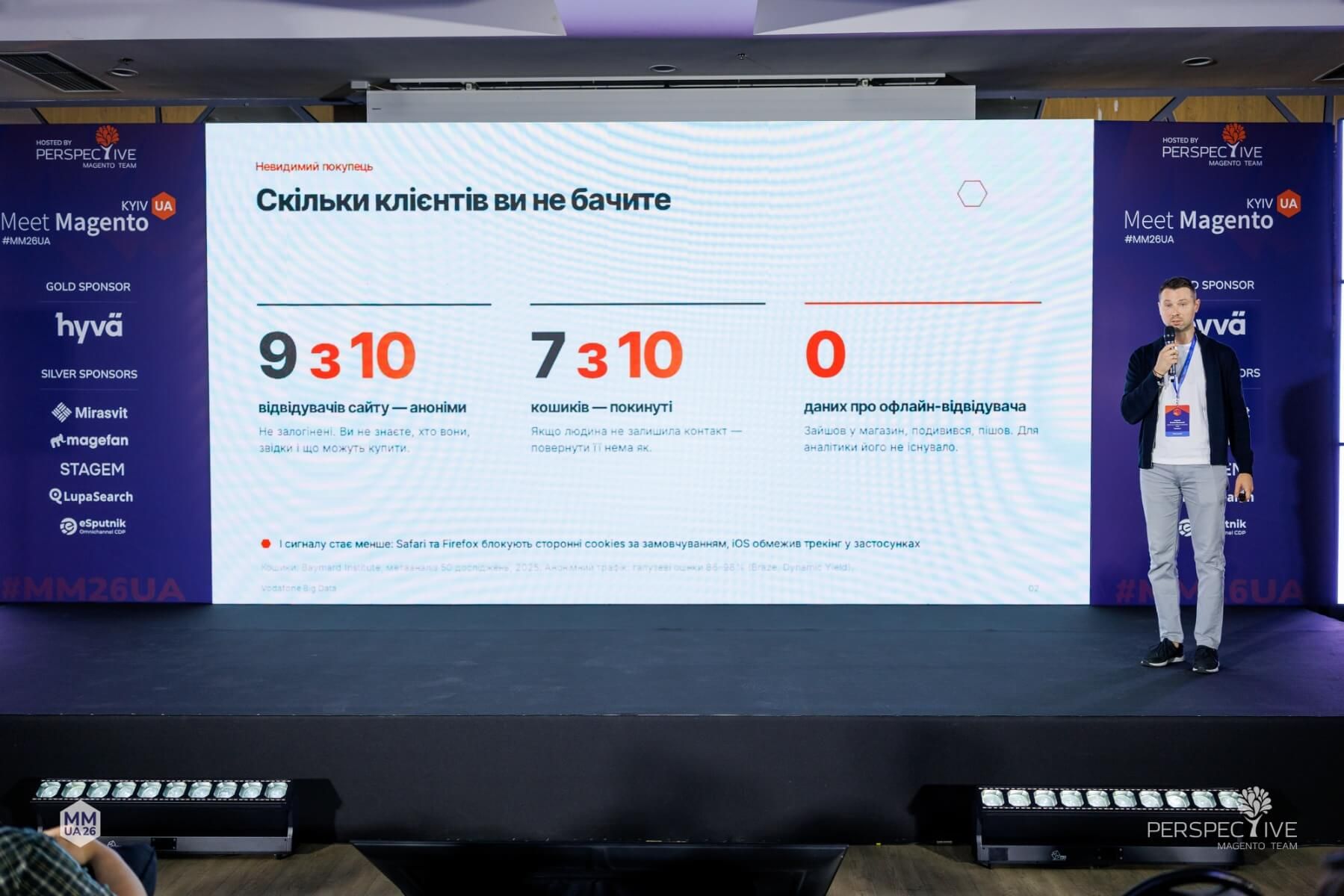
▶️ Watch the talk (in Ukrainian)
How many people buy exactly what you sell, just from your competitor? Your mobile operator knows. Vodafone Ukraine, one of the country's three national operators, serves 17 million subscribers and holds detailed profiles for around 12 million of them.
Three retail pains. Most website visitors are anonymous. Carts get abandoned. And quality control in physical stores is close to zero: mystery shoppers are expensive and can't cover every location. Telecom data addresses all three.
What an operator knows. Four to five petabytes of data pass through Vodafone's network every day: location from base stations, mobile internet usage, billing, devices, even call-centre conversations. Events run through around 3,000 behavioural patterns in near real time. The accuracy of Vodafone Analytics models reaches 85%; gender is identified with over 90% confidence, age within a five-year band. The model predicts a phone upgrade three months ahead, including the brand a person will switch to. And yes, it knows that an iPhone doesn't mean high income: it may well have been bought on credit.
Customers you can't see. Your site traffic is only part of your market. In consumer electronics, one retailer could discover 1.2 million customers who buy the same products from competitors but have never visited its site. Your own analytics won't show this audience. Operator data will.
Where your audience actually lives. Vodafone sees how people move through a city every day: where they live, work and pass by. The city is split into hexagons from 5 km down to 100 m, each with headcount, demographics and interests: children, taxis, cafés, banks. Planning a new store? The operator builds a heat map of people who buy similar products, and the districts with the best odds light up. Opening a store is expensive; picking the wrong location costs far more. Ukrainian cities already use the same data to plan transport and evacuation routes.
RCS: the next generation of SMS. RCS (Rich Communication Services) is a GSMA standard designed to replace SMS. Messages land in the phone's native Messages app, no separate messenger needed, but can carry a brand logo, images, buttons or a product carousel. Android supports it, and iPhone has since 2024. For businesses, that means messenger-level features at SMS-level cost, with higher conversion because messages don't disappear into spam or a separate folder. Vodafone is also testing the same audience segments in display ads, Meta Ads and Telegram Ads; early results show lower acquisition costs and lower CPM.
Triggers, not blasts. Messages can fire on a specific action: someone enters a mall, opens an app, browses a category. A campaign for mall visitors converted just over 1% into purchases, with the message arriving within minutes of entry and only to people who matched the profile. A watch retailer saw 23% efficiency on targeted ads.
Vodafone Pixel and abandoned carts. Vodafone Pixel is a snippet on your site, like any ad-platform pixel. It recognises a visitor's profile before login (for now, only Vodafone subscribers browsing on mobile data, not Wi-Fi). That opens two options:
- personalisation from the first screen: show a mother with young children products for her, not gaming consoles;
- recovering abandoned carts within 5 minutes, an hour or the same day, through any channel: RCS, display, Telegram Ads, Meta.
The technology is in testing, and Vodafone is looking for large sites for a free pilot.
Now imagine combining the two: a shopper abandons a cart online and walks past your store the next day. A discount on that exact product, at that moment, and online and offline become one funnel.
AI that listens to sales staff. Vodafone records and analyses call-centre conversations on its own in-house platform, and sales grew by 15–21%. Two things made the difference: agents knew every call was assessed, and they received the best sellers' practices daily. The first version failed, by the way: the AI gave advice with no context. It only worked once the team spent six months building a vector database of all calls and started measuring whether agents actually applied the recommendations. Supervisors who used to listen to calls retrained as prompt engineers, and onboarding new staff became much easier.
For physical stores, Vodafone is developing Audio Badge, a wearable for sales staff that runs 12+ hours, has several microphones and an accelerometer (to check it's on the person, not in a drawer). It tracks whether staff follow service standards and offer complementary products: buying a phone? Add a case and a screen protector. Target price: around $100 plus a small monthly subscription, with an expected +12% in revenue per store. It's currently being tested across Vodafone's 200+ stores.
What about privacy? Vodafone doesn't sell raw data: clients never receive a single phone number or name, and the operator works like a full-service marketing agency. According to the company, everything is GDPR-compliant, with consent collected the same way as for cookies and analytics. In Europe, this model is already live: operators including Orange and Vodafone have set up joint companies to build advertising businesses as an alternative to Google and Meta.
Takeaway: telecom operators no longer just sell connectivity. People pay less for minutes and use more digital services, so operators are diversifying into full-scale data businesses. For Ukraine, there's an added upside: Google is unlikely to invest in the quality of Ukrainian audience segments the way it does for the US or Western Europe.
Panel: the pitfalls of building a marketplace
Denys Studennikov (Turum-burum, moderator), Volodymyr Polishchuk (EVA.UA), Yevheniia Chubar (Nova Digital, formerly ALLO), Shahin Musaiev (ex-PAMPIK / MAUDAU)

▶️ Watch the discussion (in Ukrainian)
The panellists know the subject first-hand. EVA is Ukraine's largest drugstore chain with 1,173 stores, and its marketplace on EVA.UA already lists over 500,000 SKUs from 600+ merchants, with 3.3x GMV growth in 2025. MAUDAU is the marketplace launched in 2021 by Fozzy Group, the owner of Ukraine's Silpo supermarket chain.
You often hear that a marketplace is the natural next step for any retailer. The panel called that a myth. Before inviting third-party sellers, answer two questions honestly: why would sellers come to you, and why would shoppers buy products from you that aren't yours? No answers, no plan. A marketplace is a different game: you become an IT company with permanent development costs, you share the customer experience with sellers (and shoppers will blame you for their poor logistics), and category managers who spent years selling "their" products suddenly have to grow competitors. Then there's the chicken-and-egg problem: sellers come for traffic, so without a "donor", such as your own retail chain or, in the case of monobank with its 11 million clients, a banking app, getting the platform off the ground is very hard. There are good scenarios too: Ukrainian power-tool brand Dnipro-M, whose range naturally invites complementary products like lubricants and consumables it doesn't make itself.
The panel also discussed taking a marketplace into new countries. An asset-light model looks easy to scale, but nobody knows you in a new market, so you start from zero: sellers and traffic again. The technical side, multi-language and multi-currency that Magento supports out of the box, is the easy part. Everything else is hard: different shopper behaviour and expectations, new payment providers, logistics, banks, legislation, licensing for certain product categories. Of the old business, only the code really carries over. The panellists couldn't name a single marketplace that successfully expanded from Ukraine to other markets, so the move only makes sense when research confirms demand and you know the local market inside out.
How to grow globally without losing to yourself on marketplaces
Shahin Musaiev, serial eCommerce entrepreneur, ex-PAMPIK / MAUDAU, guest lecturer on the Commercial Director course at Laba business school

▶️ Watch the talk (in Ukrainian)
Shahin has spent 15 years building eCommerce. He took PAMPIK to the top of Ukraine's online children's goods market (the store has since been merged into MAUDAU), launched the MAUDAU marketplace, and now builds turnkey infrastructure and operations for online sales. No easy recipes here: the talk was about how to think and how to count.
Everything becomes a marketplace, and that's not an exaggeration. Worldwide, demand concentrates on large platforms, and Ukraine is no exception: the Rozetka group alone accounts for around 76% of revenue among the country's ten largest online retailers. There's still room for own stores, but proportionally far less. So the question isn't whether to sell on marketplaces, but on what terms.
1P, 3P and 2P: where control really sits. In the 1P model, you sell your goods to the platform: you deliver a pallet to its warehouse, and it does the selling. Simpler, but the platform decides whether to buy your products, which SKUs to list, how your listings look and what price you're sold at. In 3P, you sell directly as a merchant and control much more, but the operations are on you.
Why will 3P keep growing? Investors prefer it. A marketplace promises "we have everything", and building that assortment through 1P alone means freezing huge amounts of capital in stock. The financials also look very different. Buy a product for $80 and sell it for $100 under 1P: a 20% margin. Sell the same item through the marketplace for a 10% commission: $10 revenue, and a margin of… 100%.
Between 1P and 3P there's also 2P: a model with an operational layer. The brand controls product, assortment, prices, rules, data and customer relationships, and delegates catalogues, listings, orders, stock, payments, support and returns to a dedicated operator. That way a brand can be present on many platforms at once at lower cost. Shahin's conclusion: to control your brand's eCommerce, you don't have to become an eCommerce project yourself.
Are you actually making money? Growing marketplace sales aren't profit yet. P&L tells you whether you're earning; cash flow tells you whether there's money in the account. When a business scales fast, it's easy to ride a cash cushion and assume all is well, until sales slow down and creditors want to be paid.
The metric that matters is not gross margin (revenue minus cost of goods) but contribution margin: revenue minus all variable costs, including marketplace commission, fulfilment, logistics, returns reserve and advertising. It shows whether you earn on each transaction. If you don't, the more you sell, the more you owe.
Not every order is equally valuable, and costs are hard to allocate. How do you split an order-level discount across products when some have a minimum price? Excel won't save you. You need all your data in one place and unit economics by platform, SKU and order. And no, AI alone won't help if the data is bad: garbage in, garbage out.
Marketplaces and D2C aren't competitors. A common line of thinking: marketplaces take a big commission, so let's build our own site and keep it. It doesn't work that way. The channels play different roles. A marketplace gives you a fast start and wide distribution, with traffic and processes already in place. D2C, your brand's own site, gives you a direct relationship with your audience, first-party customer data and control over the experience. People go to a marketplace to just buy; they come to a brand's site because they know and trust that brand.
But D2C is hard. You need to drive your own traffic and build the storefront, support, warehousing, delivery, payments and returns. Internationally, Amazon FBA solves part of this: brands fulfil both Amazon and own-site orders from one warehouse. Ukraine has no equivalent yet.
More marketplaces, more headaches. In Europe, a seller is present on six marketplaces on average. In Ukraine the list fills up quickly too: Rozetka; MAUDAU; EVA; ALLO, a national electronics retailer with pickup in more than 100 cities; and Epicentr, whose marketplace had 25 million monthly visitors as of 2024. Managing all that without a central control panel is very hard, and such tools are starting to appear.
What about AI? AI shopping traffic is still small, around 0.2% in 2025, but it's growing fourfold and converts better. Shahin reminds us that people were once just as sceptical about eCommerce being "not for everyone", yet in 2020 even Ukraine's big grocery chains moved online en masse. Still, don't build illusions: large platforms will most likely capture most AI traffic, since they're already embedding AI recommendations and review summaries. So the key question is how to stay visible inside a marketplace. The answer is product data quality: structured attributes, complete digital content, and one central system instead of ten. D2C doesn't disappear either: exclusives, early launches, drops, subscriptions and loyalty. You buy your favourite band's limited vinyl on their site, not on Amazon.
What's changing:
- Marketplace or D2C → a portfolio of channels.
- One central warehouse → a fulfilment network.
- Unit economics in Excel, after the fact → real-time economics: SKU × channel × order.
- Teams managing products by hand → data, software and AI on top.
- The channel controls the brand → the brand manages channels through an operational layer.
When products sell through several channels and ship from a network of warehouses, the same item lives in many systems at once. Shahin's point applies again: whoever has high-quality product data in one place wins. That's what we're working on at Eltrino too, building Vidisape, an AI search for eCommerce that enriches product cards with synonyms and tags, understands queries in multiple languages and supports multi-warehouse fulfilment.
From attention to influence: how consumers are changing brands
Kyrylo Yezhov, Business Development Director, KANTAR Ukraine
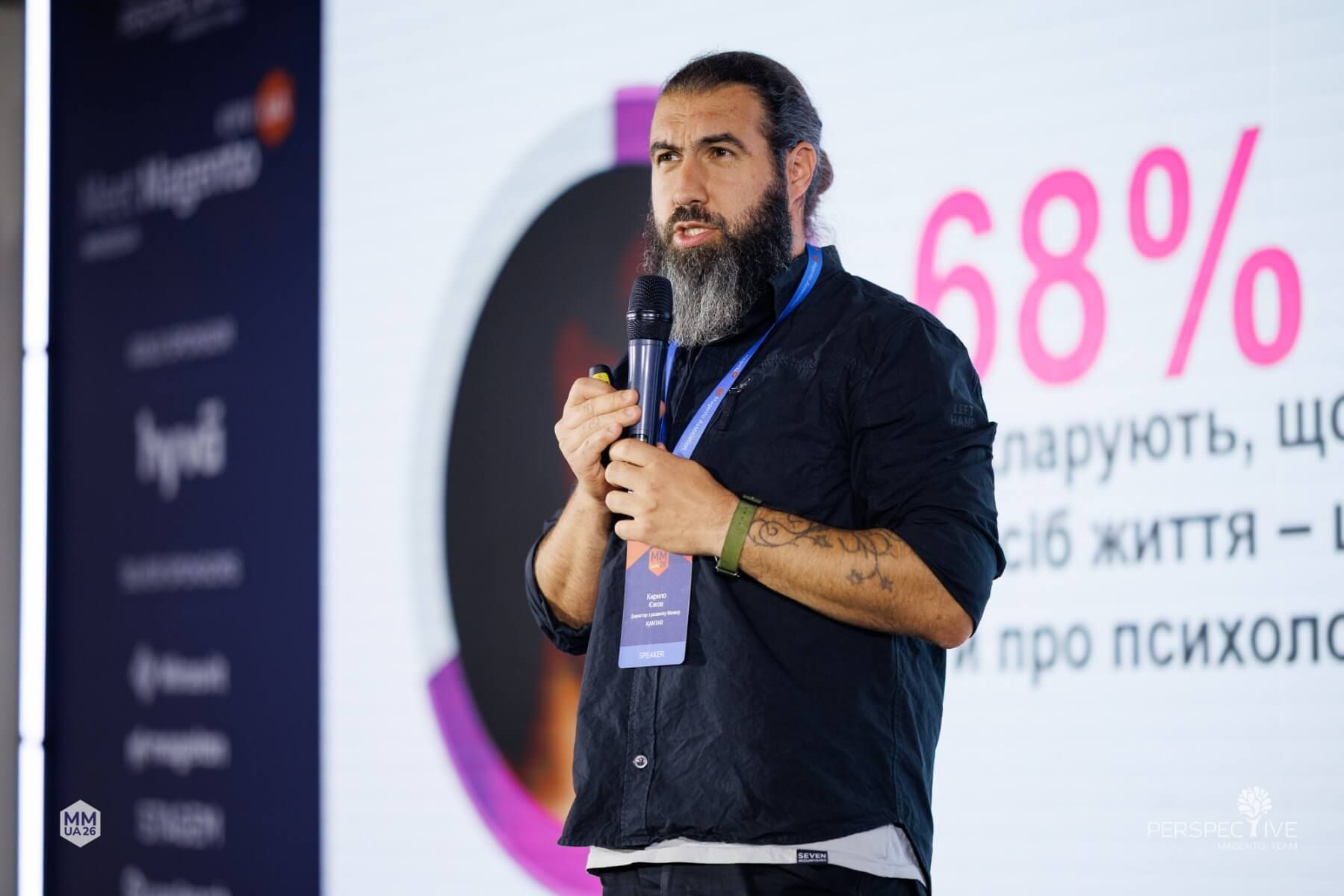
▶️ Watch the talk (in Ukrainian)
KANTAR's research for the first half of 2026 (urban population aged 18–55) paints a picture of shoppers living with constant stress and financial caution, yet unwilling to compromise on quality. The consumer sentiment index stands at 78 (anything below 100 signals negative sentiment). Five numbers worth knowing for anyone selling in Ukraine:
- 62% of Ukrainians are cutting back, and for the first time in years of research they're even cutting spending on mobile and internet. Pets, however, are the last thing they'll economise on. Most importantly, saving money doesn't mean accepting lower quality. This trend has held throughout the war and existed before it. If a café switches to cheaper coffee to hold its price, customers won't stay; they'll go and try somewhere else. Cutting quality to protect price is the fastest way to lose a customer.
- 35% will switch brands if a product gets more expensive. The other 65% stay, but hunt for promotions or a cheaper seller elsewhere. Loyalty is conditional: discounts attract, but they don't retain.
- 92% of customers who face high effort become disloyal to the brand. Shoppers want simplicity and predictability, not a "wow effect".
- Only 22% trust AI recommendations when shopping. What they want from an AI assistant is mainly price comparison and an explanation of the differences between products.
- 28% are ready to buy on a blogger's recommendation. Influencers work best when the person is already close to buying and when they're honest about pros and cons. Yet brands often get lost in these integrations: colours, logos and slogans go unused.
It pays brands more to simplify the interaction than to motivate. Fewer steps to purchase, clear prices and terms, honest communication: that is today's "premium". Promise less, guarantee more. As KANTAR puts it, better to be simple than insincere.
Panel: Magento in the Composable Commerce era — monolith, headless or hybrid?
Sergii Lysak (Eltrino, moderator), Vasyl Pastushenko (EPAM), Oleksandr Semchyshyn (Vaimo)

▶️ Watch the discussion (in Ukrainian)
When headless technologies first arrived in eCommerce, they came with a lot of marketing promises: headless was supposed to solve everything. A few years on, the market has enough experience to say what actually worked and what didn't. The panel was moderated by Eltrino CEO Sergii Lysak, and the experience of all three companies turned out to be strikingly similar.
Which headless solutions looked great on paper but disappointed in practice? Adobe PWA Studio projects ran into a long list of problems, starting with search and SEO: Google can parse client-side rendered (CSR) sites, but other bots can't. Add proprietary technical components nobody else used, a small community, and the need to duplicate every module. When Google made Core Web Vitals a ranking factor, many PWA sites dropped in search.
Vue Storefront brought the same upgrade pain Magento already had. In real projects, ready-made components required so much customisation that little of them remained. ScandiPWA was similar: by launch, about half the code was still ScandiPWA, the rest custom. Eltrino's experience matches. These technologies aren't bad, but the cost of entry, cost of maintenance and difficulty of evolving them eventually push teams towards their own solutions. And Hyvä solved Magento's frontend performance problem without going headless.
Magento Open Source vs Adobe Commerce: does it matter for headless? The core is the same, so technically you can build headless on either. The difference is budget and ecosystem. Headless is somewhat easier on Adobe Commerce, since Adobe is developing its own service stack. On Open Source, budgets are limited in 90% of cases, and of the thousands of marketplace extensions only a handful support headless properly, so you invest more in the frontend and get less back. That said, Open Source doesn't automatically mean a small project, and for some complex builds headless is fully justified.
When monolith, when headless. There's no universal answer, only questions to answer honestly. Headless makes sense when the store integrates external systems, such as PIM, CMS, third-party search like Algolia or personalisation tools, and there's budget for several teams, DevOps and architecture. As a rough guide: companies with revenue in the tens of millions per year. A monolith is better when you need speed to launch, flexibility, ready-made extensions and a compact in-house team.
And crucially, a monolith doesn't limit scale. The panellists cited a US retailer with over $1 billion in annual revenue running on Magento's Luma theme, and a Vaimo project where a monolithic Magento handles 30–36 million requests a day, with properly configured Varnish, Redis and JavaScript bundling. Meanwhile, clients who invested in composable architecture five years ago are now rethinking it: it proved expensive and hard to maintain.
On speed: with Hyvä, good Core Web Vitals on a monolith are entirely achievable. According to HTTP Archive, 68% of Hyvä sites pass all three Core Web Vitals. But in a monolith and in headless alike, it's just as easy to ruin your score, so it needs constant attention.
Headless and SEO: where the problems hide.
- In headless, pages render in the browser, so SEO tags may simply never reach the bots.
- Redirects work out of the box in Magento, but in headless they must be implemented separately on the frontend. One case: a custom URL type that returned 404 via GraphQL instead of redirecting.
- Canonical tags: category filters and products in multiple categories create confusion, and the drop in rankings is often noticed months later.
- Google can execute JavaScript, but most LLM bots can't, so without server-side rendering your site is nearly empty to them. Next.js and similar frameworks essentially replicate what Magento does out of the box: render HTML on the server and cache it. A separate, LLM-optimised version of content may soon be needed too. For headless, that means a backend team, a frontend team and someone who understands SSR, SEO and LLM optimisation at once. Such people are rare and expensive.
Hybrids. An interesting insight: almost everyone who has worked with Magento 2 has already worked with a hybrid. The standard one-page checkout is built on the REST API, a headless island inside the monolith. Other examples from the panellists' practice:
- A Luma site plus Adobe Experience Manager for content, because the marketing team disliked Page Builder. Expensive in licences, but running smoothly for over three years.
- Product configurators: made-to-order furniture where the smallest product had around 100 variants, or prefab houses bundling 6,500–7,000 products. No standard template can handle that, so the configurator runs separately and passes a compact result back to the Magento cart.
- Microservices for a major Ukrainian electronics retailer. An Eltrino project from 2018–2019, before Hyvä existed: the most heavily loaded parts, product and category pages, were gradually moved into separate microservices. The result was a "monolithic hybrid". It was a risky and costly decision, but it made the site significantly faster and paid for itself.
- Media on an external CDN service that resizes and processes images itself. For a catalogue with terabytes of photos, this proved both faster and much cheaper.
What 2027 will bring. The main driver of change is, of course, AI agents. Platforms are already preparing: support for MCP and new agentic commerce protocols, and content that LLMs can read and understand. The panellists also discussed IoT: electronic shelf labels that update over Wi-Fi already exist, and it's logical for them to sync directly with Magento.
Sergii Lysak's forecast for the Magento ecosystem: the coming year will lean towards the monolith, and Hyvä will keep its lead. Headless remains important but niche and costly; Eltrino builds such projects too. Oleksandr Semchyshyn added that Hyvä has done a great deal for the Magento community by helping keep the ecosystem open.
The technical foundations of cloud search
Paulius Nagys, Co-founder & Growth, LupaSearch
▶️ Watch the talk (in English)
Black Friday, 9 a.m., the first campaign goes live, and within five minutes traffic jumps tenfold. For some stores, these days bring up to half of annual revenue, so search must not just survive but sell. Yet "the server didn't go down" is like a pilot saying "we didn't crash" after a flight: necessary, but not enough. Search has two key aspects: technical resilience and understanding what the shopper is looking for.
Resilience. Paulius explains search architecture through everyday analogies. Isolated clusters work like separate fuse boxes in an apartment block: if one flat blows a fuse, the rest of the building keeps its lights on. Separate read and write indexes with instant switching keep catalogue updates from slowing down search.
Understanding. The biggest problem in search is still synonyms. A furniture store writes "sofa" everywhere, a shopper searches for "couch" and gets zero results. It used to take two people per language working all day to maintain synonym databases. Now LLMs generate them, and 20 languages run automatically. Search can also "see" images: the CLIP model recognises a floral print on a yellow dress even if the description never mentions it. And to avoid paying millions for an LLM on every query, LupaSearch calls the model only for the 1–2% of searches that return zero results. The system remembers the answer, and the next shopper gets it without the LLM.
Search as a salesperson. Beyond language, there's a commercial aspect that's often forgotten: margin, stock levels and sales priorities should shape results. Another real case: a large bookstore in the Baltics lost sales on Black Friday on its most popular "product", a gift card, simply because it was a CMS page rather than a product, so search couldn't find it. Today, shoppers use on-site search not only for products, but for store opening hours, return policies and blog articles. And since ChatGPT, they increasingly type questions instead of keywords, so the future of eCommerce search is question and answer.
AI agents in internal processes: from a chatbot to a team of 20+ agents
Roman Lobovskyi, CTO, Mirasvit
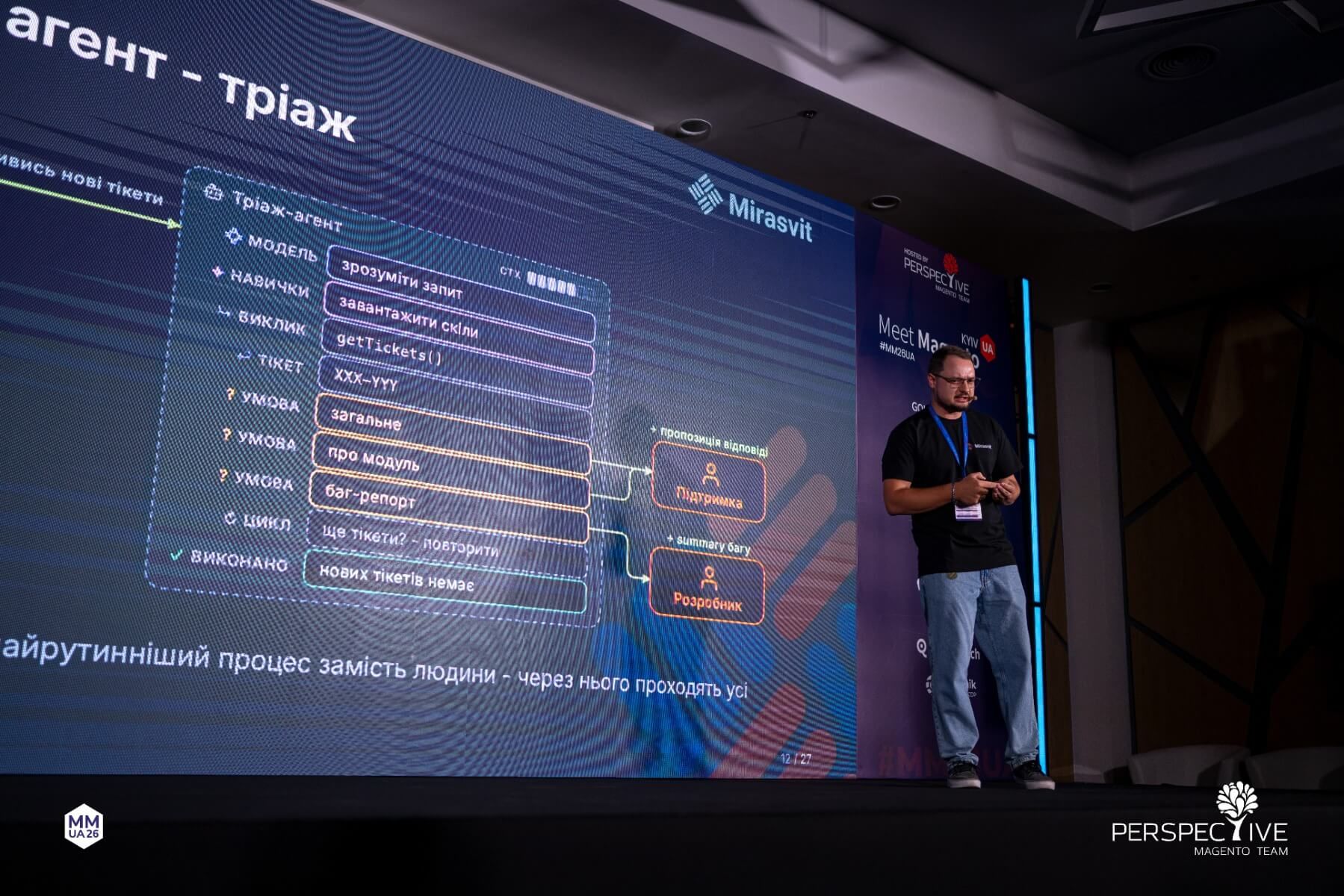
▶️ Watch the talk (in Ukrainian)
Mirasvit, a Magento extension vendor with around 60 modules, went from a simple AI assistant for its helpdesk in 2023 to 20+ agents whose instructions add up to roughly the length of the first two Lord of the Rings books. The turning point was an MCP server. Before it, a person had to copy data between the ticket and the agent by hand. After it, it's enough to write "check what this customer wants": the agent goes into the store, checks orders and payments, and drafts a reply. From a phone, you can ask for last week's sales report without ever opening the admin panel.
The path wasn't straight: the team kept experimenting and looking for weak spots. One lesson: an agent that reviews its own work often misses errors because it "knows" everything is fine. So reviews go to a separate agent with a clean context, one that knows nothing about how the result was produced and simply checks it.
For eCommerce, the same approach fits agents that monitor store health, analyse sales, handle merchandising and manage stock. And shoppers are already arriving with agents of their own: Silpo, Ukraine's leading supermarket chain, has launched its own MCP server, letting customers connect their account to an AI assistant, review past purchases, find discounts and potentially place orders. AI traffic is growing, and its conversion is starting to outpace other sources. So online stores should prepare to talk to agents, not just with content, but with tools an agent can use to work with the store.
How AI is changing digital marketing: the new rules of the game
Maryna Volynchenko, Sales & Strategy Director, Webpromo
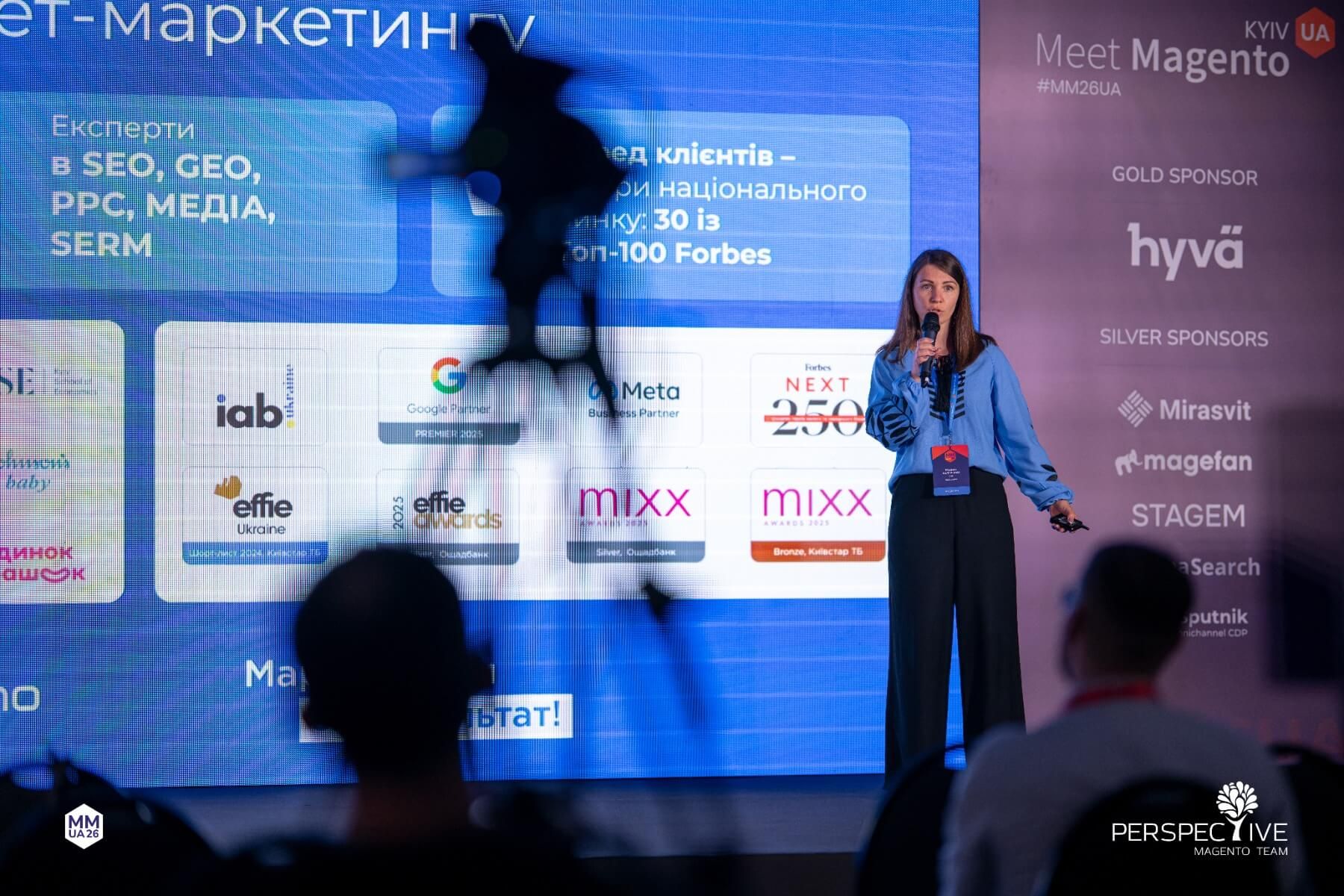
▶️ Watch the talk (in Ukrainian)
Your website is no longer the only place where customers decide to buy. Part of the journey now happens inside AI, and businesses can neither see nor control it. Webpromo's own research shows how concentrated this already is: ChatGPT generates around 90% of AI-chatbot traffic to Ukrainian eCommerce sites.
Search became a single task. The path to purchase used to be a chain of separate searches. Someone with a skin problem looked up helpful ingredients, then brands, then reviews, then where to buy. Today one prompt is enough: "find me a cream for dry skin under $25 from a Ukrainian brand." AI returns options, comparisons and links at once. The journey is no longer linear, and Google is losing its status as the single point of entry. For the shopper, it's still one search. For the business, it's dozens of touchpoints, each a fight for visibility. That's why it matters to understand not only the customer's need but their micro-intents: price for some, a local brand for others, sustainability or delivery speed for others still.
Google Merchant Center is no longer just for ads. Google takes product data from it and distributes it across its whole ecosystem: AI Overviews, Gemini, Shopping, YouTube, Images, Maps. Without a feed, Google sees your products only in classic search. And Google is already testing a universal "smart" cart powered by Gemini, where shoppers can buy and even pay without ever visiting your site. The data for that cart comes from Merchant Center. For merchants, the conclusion is simple: feed quality is now a sales issue, not just an ad setting.
The biggest risk is losing direct contact with the customer. AI delivers shoppers who are already warmed up and gives small businesses a chance to compete with large ones, since it focuses on relevance rather than company size. But there's a flip side: opaque algorithms, dependence on data quality, and hallucinations that can damage trust in a brand. Above all, AI takes over the choosing stage. The brand no longer decides which message to use or which channel to talk through. You can't see how the person chose, you can't convey your unique value, and you lose data because some customers never reach your site.
The answer is to return to the basics we once wanted to automate: offline experience, social media, email, personalised offers, loyalty programmes. It sounds obvious, but right now it's becoming critical.
Three jobs instead of one. Organic marketing is no longer just about commercial pages. Businesses now have three jobs:
- Be found: classic SEO.
- Be the answer: AEO, appearing in AI Overviews. They take up the top of the screen and reduce organic CTR, but mostly for informational queries: guides, how-tos, specifications. Commercial queries still belong to organic results and ads.
- Be recommended: GEO, appearing in answers from ChatGPT, Gemini and other LLMs. People come here for dialogue and deeper research: "recommend top Ukrainian vyshyvanka brands", "suggest corporate gifts and where to buy them". LLM traffic is many times more valuable, because the person has already compared options and is effectively choosing you.
How to get into AI answers. There's no magic formula, and it's clear why: years of SEO manipulation have cluttered the web. New algorithms push content to be genuinely useful again. What to focus on:
- Technical accessibility. If your site blocks LLM crawlers, AI won't see you.
- Intent, not keywords. A computer description that never says it's a gaming PC won't appear in answers for someone looking for a gaming PC.
- Brand authority. LLMs cite brands people talk about and leave positive reviews for. For LLMs, a brand's digital footprint matters most.
- Completeness and facts. Text for the sake of text doesn't work. You need numbers, expert opinions and links to primary sources.
- Topical authority. A coffee machine store with basic descriptions won't become an expert in AI's eyes. A store that helps people choose, explaining differences between models and types of coffee, has a chance of being recommended.
- E-E-A-T and trust. Real photos, videos, reviews, and clear payment, delivery and warranty terms. These are signals for algorithms and for the people choosing you.
We've written more about how online stores can earn AI recommendations in our article on GEO for eCommerce.
It can already be measured. For LLMs, you can see traffic and conversions from specific systems and the pages where they happened. You can track how often LLMs mention your brand each month, where it ranks against competitors and whether they link to your site. Competitors' LLM traffic can be estimated in Similarweb or Ahrefs. AI Overviews are harder: analytics still shows them as regular organic traffic.
Paid ads: creative is the new targeting. People increasingly ignore and block ads, so Google and Meta algorithms now focus on current intent and hundreds of signals at once. Over two years, Performance Max and Demand Gen evolved from a "black box" that delivered plenty of low-quality leads into an end-to-end system with more control: you can exclude keywords, audiences and irrelevant placements. The combination works like this: Demand Gen creates demand, Performance Max captures it, and classic search fills the gaps.
But these are tools for scaling, not for starting. They need quality data: a customer base and clean product feeds. Learning takes two to four weeks on average and requires 30–50 conversions. In a narrow niche or on a small budget, the system may never finish learning. New additions include AI Max, which generates ads tailored to the user's query (but check its output daily), a creative studio and video generation, for now in English-language accounts.
The changes at Meta are even more noticeable. Targeting "25–35, iPhone owners" overheated the auction, and interest-based ads kept showing sofas for six months after someone had bought one. Now the algorithm starts from the person: what to show them based on their current interests. That's why creative variety decides everything. Four photos of a throw blanket in different colours no longer work. A mother and child reading under the blanket, a friend giving it as a gift, a couple at a photo shoot: those do.
Takeaway: strategy and setup now account for roughly 30% of results; the remaining 70% is creative and brand. Technology is changing radically, but strategy isn't: create value, communicate it well, and build trust with your audience.
AI agents on Magento projects: two real cases
Anton Zhuk, CEO, Whidegroup
▶️ Watch the talk (in Ukrainian)
Whidegroup is based in Zaporizhzhia, a city under constant Russian shelling. The team keeps working, and with a sense of humour.
Case 1: a site slowing down under load. While the team was building a new Hyvä frontend for a client, the old site had to hold out until release. One morning, the database started choking on queries. An AI agent analysed it and found the cause: an outdated third-party module generating a huge number of small "junk" queries. The agent proposed a caching solution and a ready architecture for a new module.
The result: those queries dropped from 200,000 to 6,000 per second, the database became 10–15% faster, and the queue and load spikes disappeared. From start to tested release took less than four hours, in time for the client's working day in New York.
But there's a catch: in its ready-made solution, the agent referenced a component it simply never wrote. An experienced developer spotted it and filled the gap in minutes; a junior would have shipped an error to production. The key takeaway: the value of an engineer who reads, verifies and takes responsibility for a solution isn't going anywhere. The client will call a person, not Claude.
Case 2: a hack on a Friday evening. A German store, a small business operating since the 1970s, received an email at 4:40 p.m. on a Friday: hackers had tampered with data on the site. The cause turned out to be mundane: two security patches had never been installed.
The agent found where the attackers had uploaded malicious files and suggested what to fix. The server was rebuilt from scratch. The whole job took four to five hours, and the client went into the weekend with peace of mind.
Both cases were handled on a standard $20-a-month subscription. But there's another level: a full AI security scan of a single web server with a specialised security agent cost the team $470 in tokens alone. Which raises an open question: who should cover costs like these, the merchant or the agency?
Panel: decision-making discipline in the age of AI
Oleksii Lunkov (DataArt, moderator), Sergiy Boryslavskyy (Vodafone Ukraine), Maryna Volynchenko (Webpromo), Dmytro Horiachev (Leroy Merlin Ukraine)

▶️ Watch the discussion (in Ukrainian)
The difficulty of execution used to filter out bad ideas on its own: the more expensive something was to build, the longer people thought about whether it was worth it. With AI, almost anything can be built quickly, so that filter is gone, while the costs of validation, rollout and support remain. Hence the panel's main question: how not to drown in AI initiatives. The panellists' practical advice:
- Start with the problem, not the tool. Separate two modes: experimenting with "what can we do with this new model" and solving specific business problems.
- Four questions for every AI initiative: is there a real need, who owns it, what's the evidence, and what's the stop criterion? Without ROI and an owner, it's not a project but an experiment at the company's expense.
- The 80/20 rule from Vodafone: the highest return comes from optimising the work of the most expensive specialists, but only with mandatory training. That's how the company rolled out Copilot: first to 100 employees, with training run jointly with Microsoft and weekly surveys. Even counting only half of the hours saved, ROI came to 130%.
- Don't ban, collect. Bans create "shadow AI": employees use personal accounts anyway.
- Keep an AI radar of initiatives across the company, so that instead of 50 chatbots you build one that works.
- Verify everything AI tells you. Models are tuned to agree with you and sound convincing, even when they're wrong.
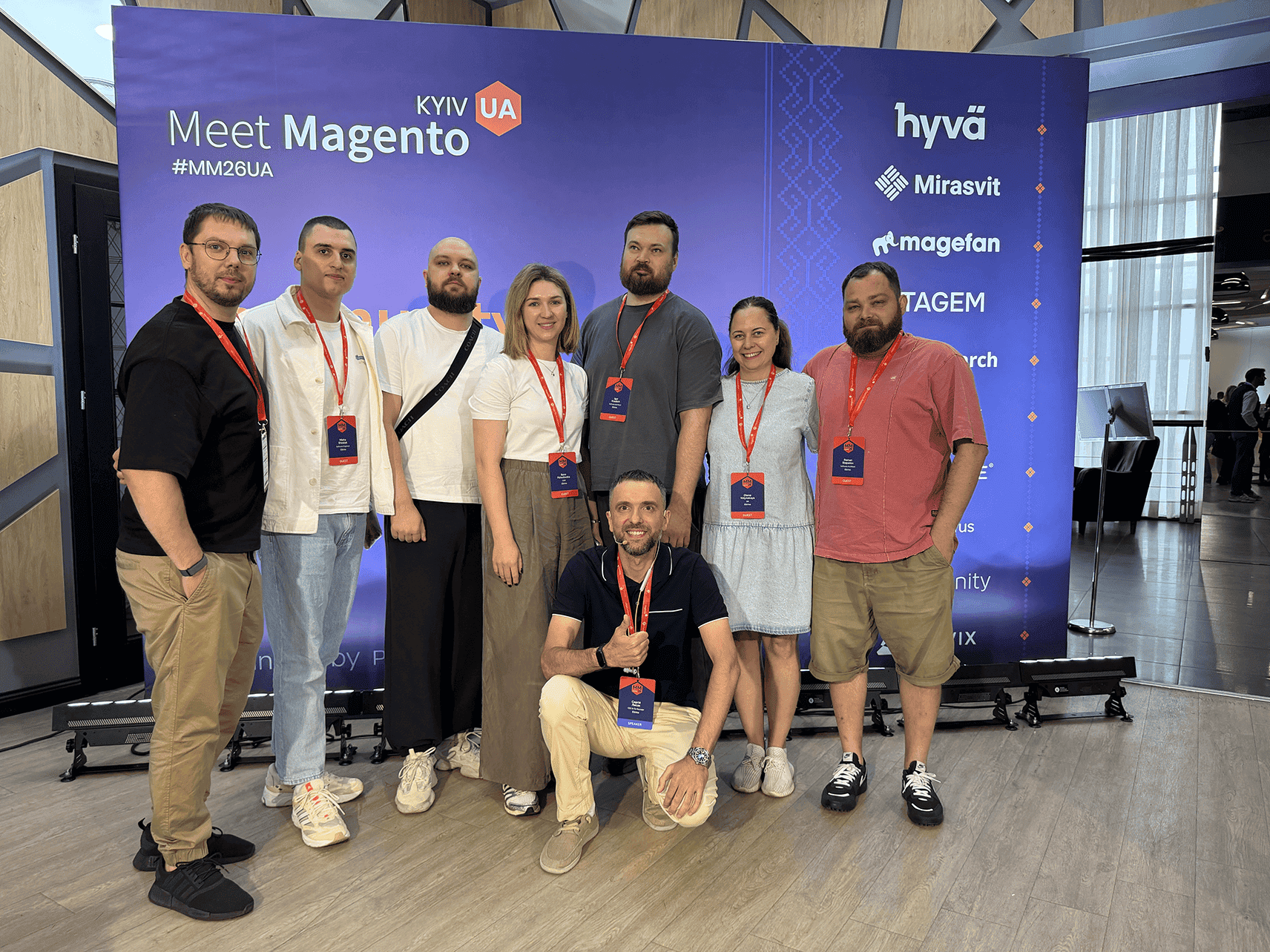
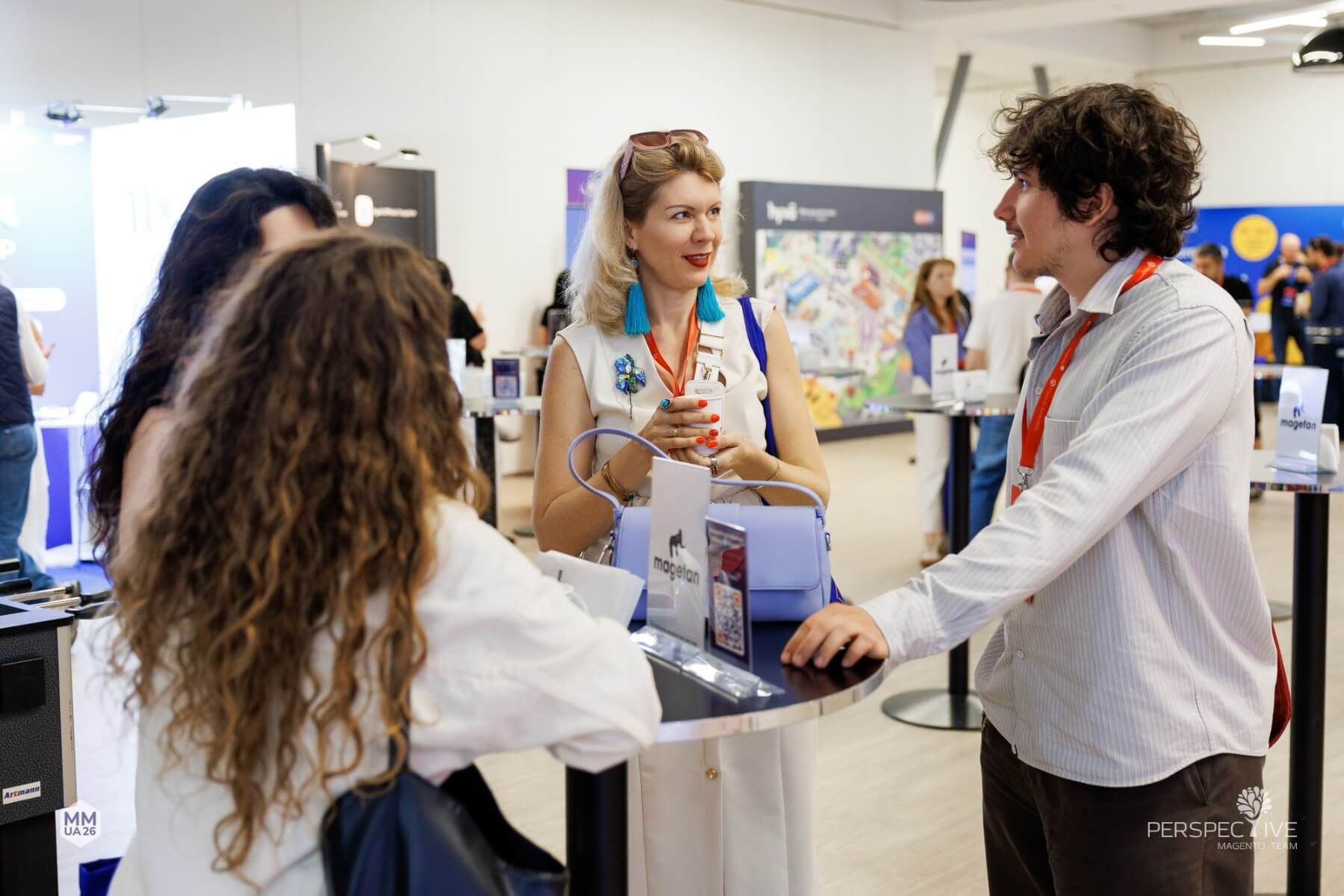
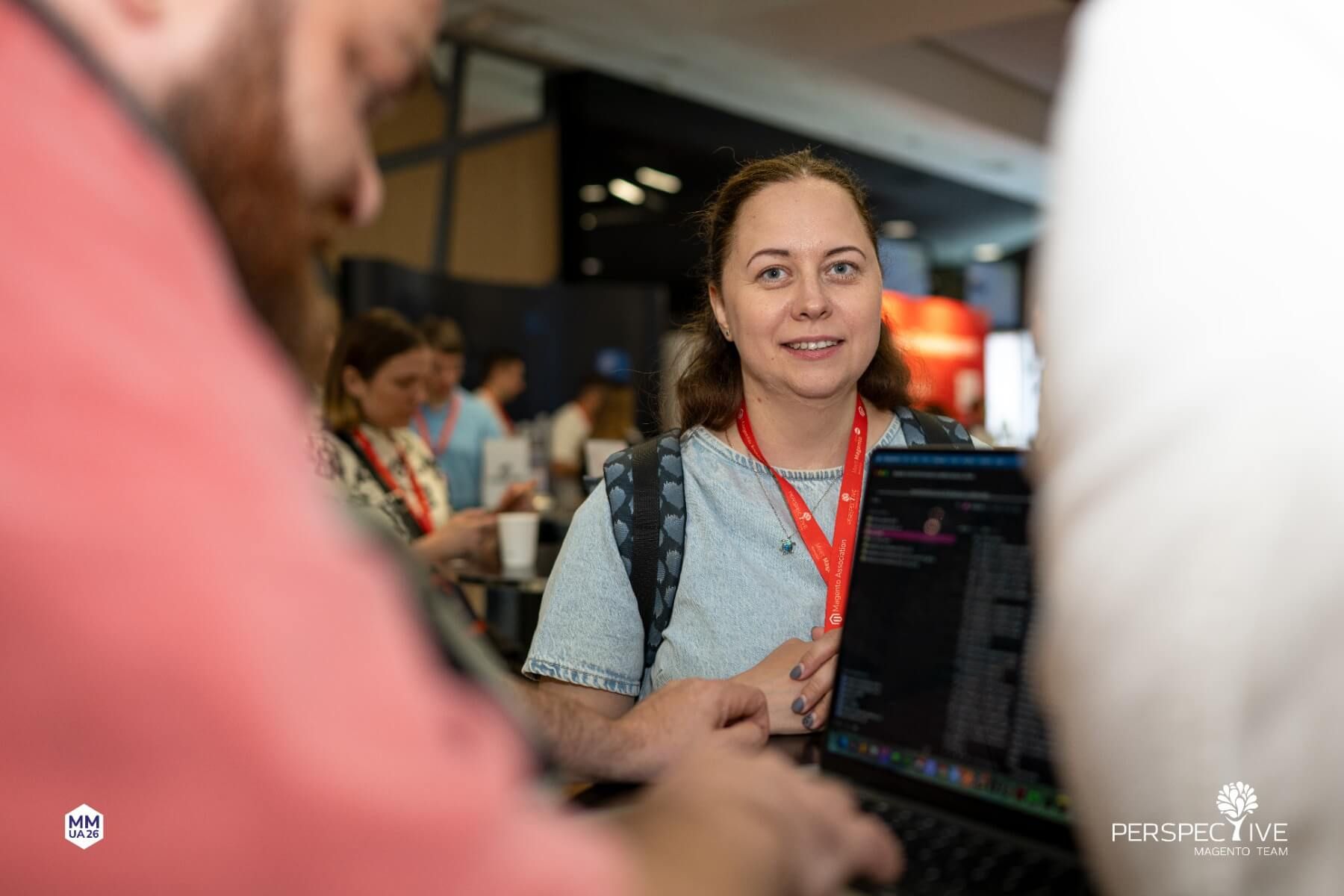
We came back from Meet Magento Ukraine 2026 full of ideas and impressions. It wasn't just talks and panels. It was meeting the people we've been building Magento projects with for years, hallway conversations every bit as valuable as the programme, and the feeling that, despite everything, we keep doing our work. So our sincere thanks go to the team at Perspective. We know well what goes into a day like this, because we once organised Meet Magento in Ukraine ourselves: sleepless nights before opening day, speakers, partners, the programme and a thousand small details that have to come together. In wartime, that challenge is ten times harder. For the second year running, you pulled it off brilliantly and turned the conference into a good cause as well: half of every ticket price went to support the Armed Forces of Ukraine. On top of that, the LupaSearch speakers brought a car and donated it to Ukrainian soldiers. Thank you to every speaker, attendee and partner. And special thanks to our defenders, who make it possible for us to gather in Kyiv.



See you next year!